Speedy Carve, I love you.

Tools of the Trade / Tutorials

Last summer I took five glorious weeks off from client work to participate in the Summer Residency Program in Illustration at School of Visual Arts. Our first assignment for Viktor Koen’s class was to create a family book-plate for ourselves. I chose to do a “field” of turkeys to represent a long-running joke in my family about a large flock of turkeys that visits my parents’ home. I drew a sketch for the idea that was cute but felt a little cartoony. I wanted to elevate it somehow. I thought it would look great as a block print but didn’t have any experience with lino cuts and I had heard it was hard on the hands and pretty easy to hurt yourself. At the art store I found what would become one of my favorite art supplies: Speedy Carve.
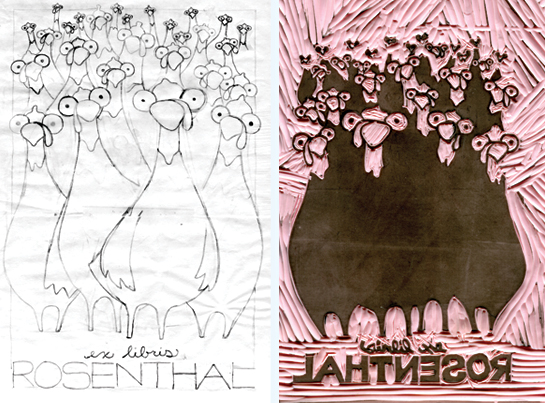
Left: My original turkey sketch. Right: The speedy carve block with some leftover black ink.

Speedy Carve is a pink eraser-like block that you can carve into with a linoleum cutter. I purchased a few blocks of it as well as a block printing starter kitsome block printing ink and some paper to print on.

One of the things I love about Speedy Carve is that it is really easy to cut and you get this great energetic, loose quality to your line, much like an initial rough sketch. The downside of using Speedy Carve over a traditional linoleum block is that Speedy Carve can degrade over time. If you want to create something that you can use over and over again for years, you should probably use a linoleum block.

Here’s some more scoop about how to create a print using Speedy Carve:

Read More

Why are all my favorite illustrators men?

Thoughts
Liz Starin, Men in illustration

Illustration: Liz Starin

Every so often, I’m asked to name my favorite illustrators: the ones who influence me, the ones whose work I hold up to my nose with my glasses off so I can study their every pen mark and brushstroke. Though it varies slightly with the seasons, the children’s book section of the list goes something like this:

William Steig, Calef Brown, Quentin Blake, Roz Chast, Neal Layton, Blexbolex, Maira Kalman, Tomi Ungerer,* Jules Feiffer,* James Marshall, Chris Raschka.

Children’s literature is a dramatically woman-dominated field. So why is this list almost entirely male?

Read More

Colored Pencils

Inspiration / Thoughts / Tools of the Trade

Above: If Cats Were Dogs and Dogs were Cats series by Ruthie Lafond.

Why do colored pencils get such a bum rap? I can’t tell you how many times I’ve been told something to the effect of: good stuff, but stay away from colored pencils.

If Cats Were Dogs and Dogs Were Cats

It is those same people telling me that colored pencils can be hard to reproduce–but I love using them. As a kid I always drew with colored pencils, maybe because almost every year for Christmas I was given a new set. Read More

Save-worthy Illustration Promotions, Part I: The Zine

Self-Promotion

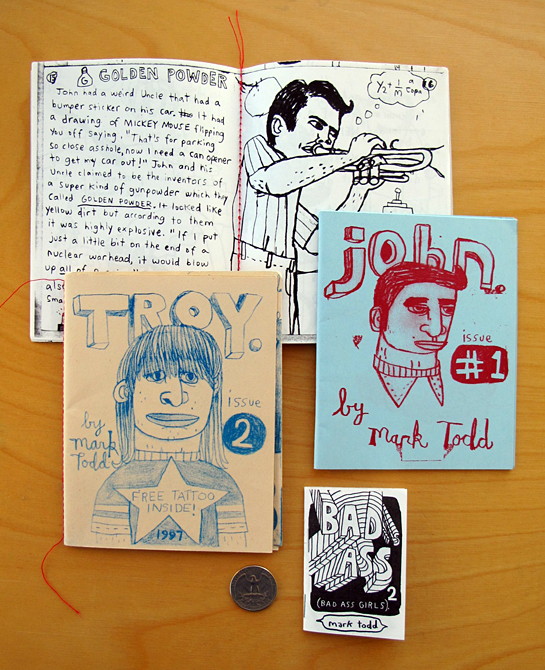
Above: Some of Mark Todd’s zines. From top: John: Issue 1 (2 different versions shown), Troy: Issue 2, and Bad Ass Girls 2.

I am both an art director and illustrator so I receive promotions from illustrators and I make my own illustration promotions to give out. As an illustrator, I always hope my promotion pieces make an impression on those who receive them. As an art director, I’ve received lots of great promos over the years but I have saved only a few. So, what makes an illustration promotion save-worthy? This post is the first in a series on just that topic.

Read More

A Pen & Oink interview, in which Abby Hanlon tells us her story

Interviews

For our inaugural interview, we’re excited and proud to introduce the fourth member of our critique group, Abby Hanlon. She’s been so busy making her first (and second, and third) book that she wasn’t able to join the blog, but we hope she’ll visit us here from time to time!

Hometown: Armonk, New York
Now lives in: Brooklyn, New York
Tools of the trade: Prismacolor pencils and a pan of watercolors (Schmincke)
Illustration idol: Arnold Lobel
Caffeine of choice: I am naturally overcaffeinated.
Workspace: We have a little room in our house, half playroom/half studio.
Favorite children’s book
…as a child: Babar and Zephir
…as an adult: Miss Nelson is Missing
Favorite thing to read: little kid handwriting
YouTube video you can’t stop watching: Jenny Slate, “What is Wrong with Books”
Must-read blog: Seven Impossible Things Before Breakfast

Woodstock, NY: Abby in her favorite place to work. All images courtesy of Abby Hanlon.

Ralph Tells A Story, about a boy who can’t think of any stories, is your first book. Where did you get the idea? Is it at all autobiographical?

I got the idea for Ralph Tells A Story when I was a first grade teacher and there was a super cool kid in my class with really messy hair who often wore a T-shirt that said, “Talk to my Agent.” I loved him. Every day during writing time, he would throw his hands up in frustration and declare that he had no story. He was the specific catalyst for Ralph, but my overall goal was to create a book that would inspire my first graders to write. I wrote the book that I wished I had had as a classroom teacher. Little kids often feel stuck during writing time, and teachers can feel frustrated. I wanted to create a book that had the potential to help both parties.

Read More

Sign up for launch news!

News

Hello, reader!

Welcome to the preview of Pen & Oink, our blog about children’s illustration. We’ll be launching for real this fall. Sign up below to be notified of our launch and to receive other Pen & Oink news!

– Ruthie, Robin, and Liz

Subscribe to our newsletter

Adding color to black and white artwork in Photoshop

Process / Tutorials

I created the piece of artwork above by drawing it first in pencil, then ink, then scanning it and adding texture and color in Photoshop. Man, I love Photoshop. Liz actually taught me this great way to color black and white artwork digitally using Photoshop and here’s how you do it:

Read More

Indie Picture Books That Are Awesome: I AM YOU

Indie Picture Books That Are Awesome

I Am You cover

I used to live in Vermont, where one of the summer rituals is a trip to Glover, to see Bread and Puppet Theater‘s papier-mâché circuses. One of the Bread and Puppet credos is that art should be cheap and for everyone.

Bread and Puppet museum

Puppets in the Bread and Puppet barn. Photo: Evan O’Neil

Accordingly, they have a stand where you can buy their posters for almost nothing. People hang them in the kitchen. There are other publications as well, booklets and calendars and whatnot, illustrated mostly with relief prints. A few summers ago, I picked up a copy of I Am You for $4 or so.

I Am You

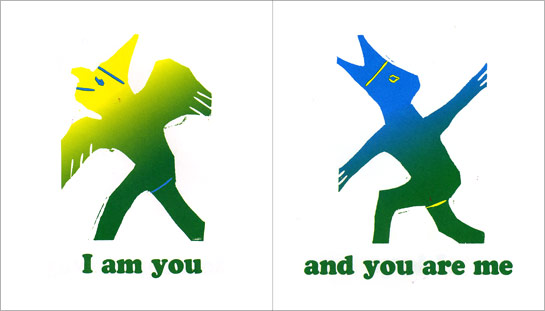
Just as a puppet show can be made of paper, paste, and junk, I Am You is evidence that picture books don’t need to be made of anything more than a few folded sheets of paper. The small book is offset printed in yellow and blue, staple bound, and only 12 pages long, with the simplest text and images you can imagine. Nonetheless, this is a complete and moving story about love, with all the symbolism two-color printing allows—it’s hard to avoid comparisons to Little Yellow and Little Blue.

It’s also hard to discuss this book without quoting the entire thing, since it’s only 28 words long (shorter than Yo! Yes?)! But I’ll try. Two individuals. One leaves; the other expresses love. The centerfold spread, which shows the bird character flying away in two crudely-cut V’s, is accompanied by “Wait! don’t go away.” Four words and two blue blobs, and it gets me every time.

Is it for children? Well, it isn’t not for children. A beginning reader could manage the text, and the story is universal. Like Bread and Puppet’s circuses, it’s for everyone.

Indie Picture Books That Are Awesome is an ongoing effort to ferret out small-press goodies and self-published gems.

Inky Persninky

Tools of the Trade

Dr. Ph. Martin Black Star MatteI’ve long been a Very Fussy Inker. Back when I was still figuring out which supplies I liked, I used Winsor & Newton india ink. At the time, I was coloring my drawings with watered-down gouache, which has a denser coverage than watercolor. But I still wanted my line to be visible.

Not all black inks give you a really good, opaque black, and some of them bleed, too. India ink seemed like a good choice, because it contains shellac, which makes it waterproof; Winsor & Newton was thick and resisted coverage, even by my, er, gouache wash. When I tried to scan these drawings, though, the shellac also tended to reflect the scanner light, which produced ugly highlights.

Then I learned about my favorite ink, Dr. Ph. Martin Black Star Matte India Ink, from Yuko Shimizu’s blog, I think. It’s been love ever since: it is a dense black, waterproof, and totally non-reflective. Black Star Matte is a little bit harder to find, but worth the fuss. I get it at New York Central Art Supply.

Then there are paper and brush choices. And that’s another story.

Pat a Mat

Animation / Foreign Exchange

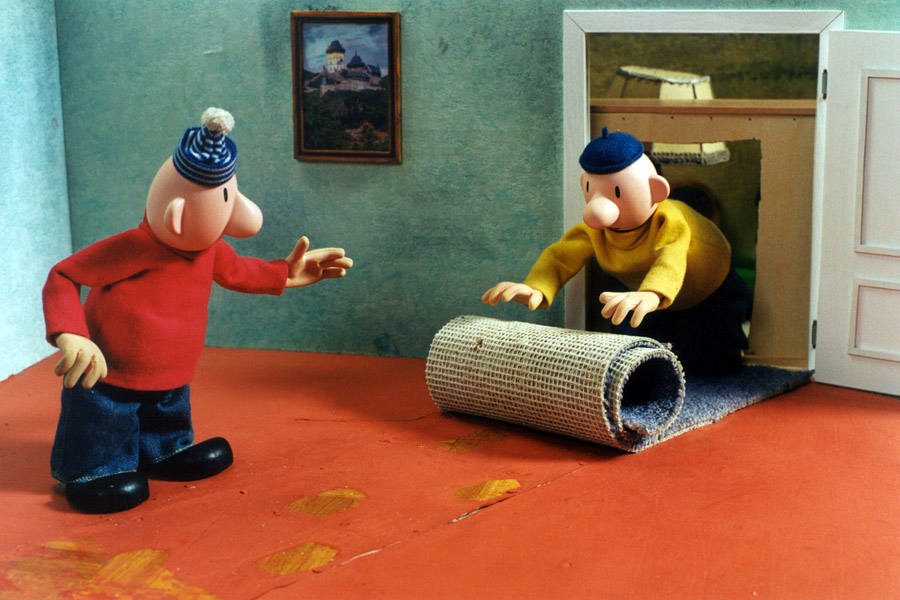
Above: Still from Pat a Mat animated series.

I could never understand the timing of Italian television programming. Things came on at random; nothing on the hour or half hour, the way we have everything neatly lined up here. One morning, we had the TV on and for a few glorious minutes my boyfriend and I were mesmerized by Pat a Mat, a Czech program. I have always been a sucker for stop motion animation; I love the painstaking workmanship behind it. Read More

I just wrote a picture book. Will you illustrate it?

Thoughts

I get asked this question a lot by many lovely and well-meaning people. In fact, I’ve answered it so many times that I’ve thought about having a boilerplate answer. Unless your name is Arthur Yorinks or Daniel Pinkwater, here it is:

Dear Friend/Cousin/Hairdresser/Friend’s cousin’s hairdresser,

Thanks for thinking of me to illustrate your manuscript. Unfortunately, I have to reserve all my unpaid time for my own speculative and personal projects.*

You actually don’t need to find your own illustrator, anyway! Children’s book editors prefer to make these matches themselves.**

In short, I will have to say

Warm regards from your friendly neighborhood illustrator,

Liz***

*Entirely true, and a polite way of encompassing some less-polite reasons, including but not limited to:

  • This is your first attempt at a manuscript?
  • Unfortunately, I haven’t read very many good self-published picture books. (I’m looking, though.)
  • Hmm, I don’t think my whimsical style would work so well for your dark historical fiction.

**See what the SCBWIEditorial Anonymous, and Harold Underdown have to say about that.

***Yeah, I have footnotes in my blog posts. That’s just how I roll.