Let’s Talk About Sex, Baby: Picture Books and Doing It

Featured Books / Thoughts
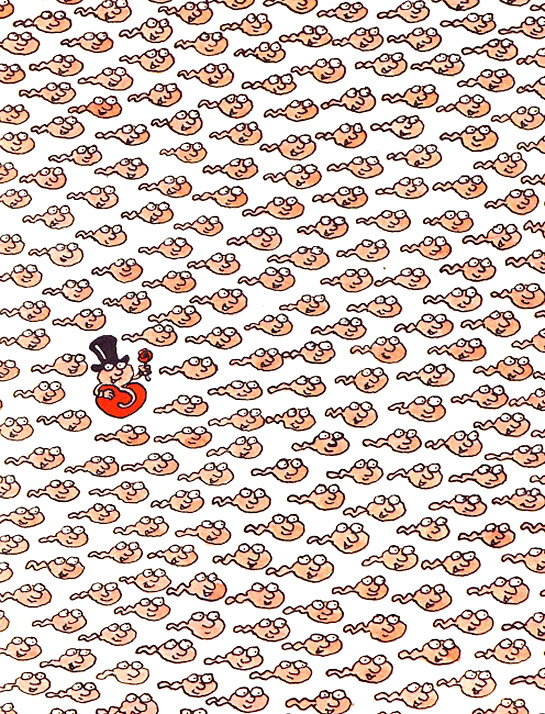
The end pages for the original hard cover edition of  "Where Did I Come From?"

CUTE SPERM: The end pages for the original hard cover edition of “Where Did I Come From?”

Last week, out of the blue, my 4.5 year old asked me, ” but how does the baby get IN the mommy’s belly?” In a not-my-best-parenting moment I cheerily said, “Hmmm I forget! I’ll have to look it up and get back to you.”

Up until this point we had gotten by with a great book called Amazing You. It’s a perfect first book on where babies come from and I recommend it, but it does not address the sex part at all so I looked for some more books on the subject.

Amazing You interior 1

A page from Amazing You. This explanation satisfied my daughter for about a year, then she wanted to know more.

I remember poring over a book called “Where Did I Come From?” as a child so I started there first. I also got It’s Not the Stork! andWho Am I? Where Did I Come From?  (The last one is by Dr. Ruth.)

Books in hand, I had the official talk with my daughter a few days later. As it is with many parenting milestones, the talk was much less of a big deal than I thought it would be. I read “Where Did I Come From?” to my daughter during bath time. “The penis goes in the vagina?!” she asked incredulously, crinkling her nose. She decided that sex sounded “yucky,” said that she would marry a boy in her preschool class, and that they would adopt. Then she changed the subject.

She did indeed have more questions over the next few days and I was glad I had all of the books to help out. Here’s a round up of the books we’ve read:

Amazing You  by Gail Saltz, Illustrated by Lynne Avril Cravath
We’ve already had this book for a year (since my daughter was 3.5) and it’s a great starter book about private parts and how babies are made. The explanations are simple and the illustrations are sweet.

Amazing-You-interior2

Amazing You is a great first book about one’s body and how babies are made.

Amazing-You-interior3

Amazing You: Saltz does a great job of explaining birth in a way that isn’t so scary for little girls.


Read More

Piggie drawings

Process / Show and Tell

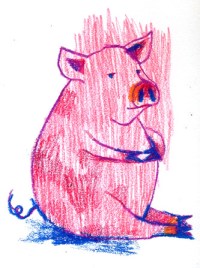
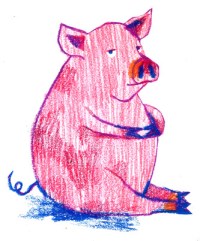
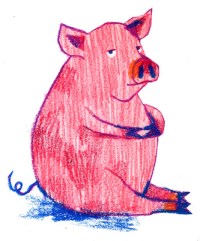
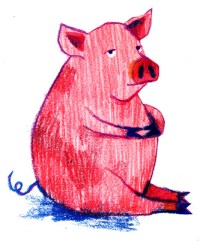
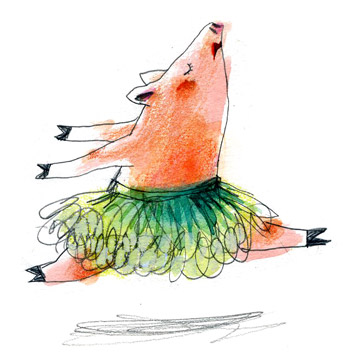
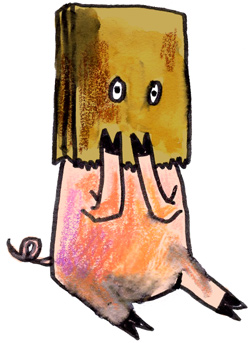
Ruthie, Robin, and I decided to make a bunch of pig drawings to adorn our new logo. For me, this little project was a chance to play with different styles.

liz-starin-pig1a

This first one is a combination of hand drawing and Photoshop. I started out with colored pencils and crayons. Because it was an experiment, I didn’t overthink things.

liz-starin-pig1b

Then I used a mask to give the pig a cutout look and better define the eyes.

liz-starin-pig1c

I filled the pig with extra pink, set on “Multiply”…

liz-starin-pig1d

…and added extra bits of color to give the piggie’s body more dimension.

liz-starin-pig1e

I also drew this weird little grandpa pig. (Like I said, I was experimenting.) It’s colored pencil with digital color.

liz-starin-pig3

And then these three, done in pencil, watercolor, and colored pencil, are more in my usual style.

liz-starin-pig2

liz-starin-pig5

A celebration of pigture books (and a CONTEST!)

Featured Books / News

We at Pen & Oink are fortunate to have the pig as our mascot, because let’s face it, children’s literature abounds with pigs. Wilbur. Olivia. Mercy Watson.

So, to celebrate our launch, we’re giving out a copy of a great pig book, Maurice Sendak’s Bumble-Ardy. Which piggie books do you love? Post an answer in the comments (please, don’t let’s all say Charlotte’s Web), and we’ll pick a winner at random! Deadline: this Thursday night, 8:00 pm, EST.

Here are some of our favorites!

Ruthie

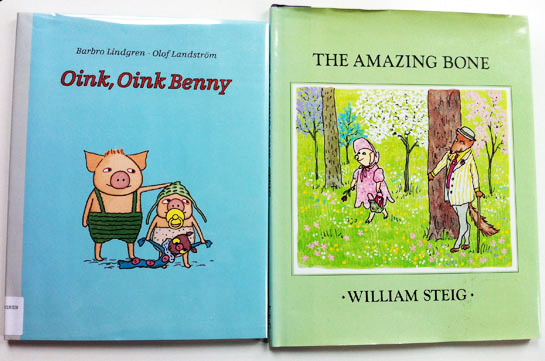
william-steig-amazing-bone-olof-landstrom-oink-oink-benny

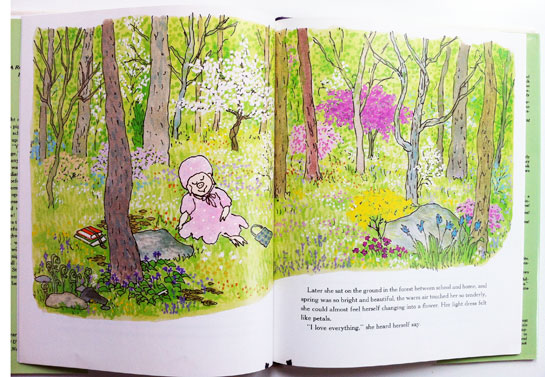
One of my all time favorite books is The Amazing Bone by William Steig, so it was easy to pick as a favorite pig book. He is just incredible and leaves me speechless. It’s as if someone dared him to write the weirdest creepiest thing he could think of and make it loveable. A bone that talks? The ladylike illustrations of Pearl the pig protagonist in happy blossoming backgrounds helps balance out the creep factor. Amazing!

william-steig-the-amazing-bone-spread

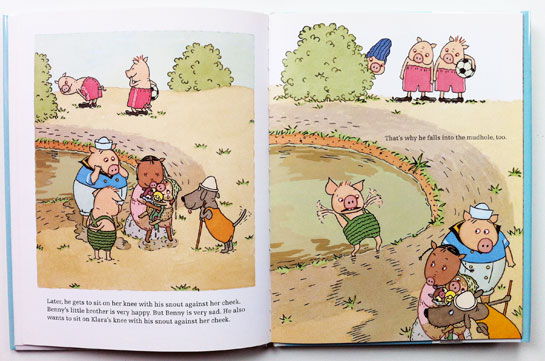
My other favorite pig book is Oink Oink, Benny by Barbro Lindgren, is illustrated by one of my all time favorite illustrators: Olof Landström.  Lindgen’s witty story takes us through Benny and his little brother disobeying their mother’s orders to stay away from the mud hole. I love the range of pigs friends they meet at the mud hole and the funny fact that there is a dog present among the pig-only crew. Landström’s illustrations are always so crisp and comical.

olof-landstrom-oink-oink-benny-spread

Robin

My hands-down favorite pig book—and one of my favorite picture books of all time—is Bumble-Ardy by Maurice Sendak. It’s one of my go-to books at bedtime.Maurice-Sendak-Bumble-Ardy-cover

There are so many great details in this book. I love the softness of the pencil line mixed with the watercolor, all the hand-drawn typography, and the mix of four-legged “regular” pigs with the clothed pigs that walk on two legs.
Maurice-Sendak-Bumble-Ardy-interiors

I also love the fact that the book is dark and weird. There are three full-page spreads of escalating mega-party in the middle of the book that are a total feast for the eyes. And Aunt Adeline goes ballistic in the end and practically transforms into a monster!

More on Bumble-Ardy from Maurice himself here:
http://www.vanityfair.com/culture/features/2011/08/maurice-sendak-201108

Liz

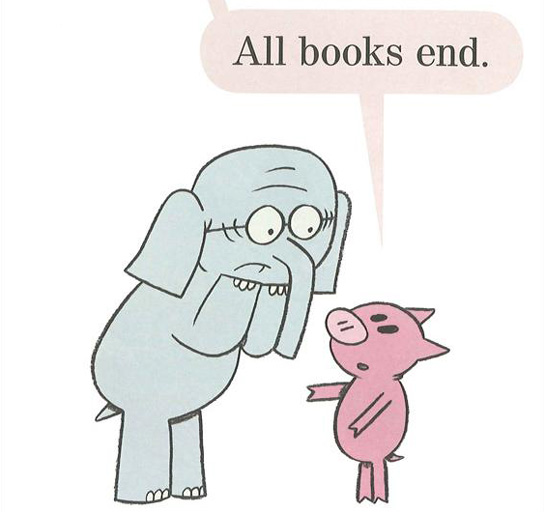
I think my favorite pig book is We Are In A Book! by Mo Willems, which is about two friends, Gerald and Piggie, who, well, discover they’re in a book. I’m a big fan of metafictional picture books when they’re done right. But the thing that really knocks my socks off is Gerald’s hilarious yet profound existential crisis: “The book ends?!”

Mo-Willems-We-Are-In-A-Book

Arnold-Lobel-Small-Pig-1

Another favorite is Arnold Lobel’s Small Pig. A small pig, much loved by the farmer and his wife, runs away to the city after the farmer’s wife overzealously cleans away his mud puddle. (Apparently women were still really enthusiastic about housework in the late sixties, when this book was published.)

It’s classic children’s book comedy, complete with Lobel’s deadpan clarity and punctuated with loving reassurance: “We think you are the best pig in the world.”

The (preseparated!) illustrations in Small Pig are printed in a simple palette of blue and yellow. This one, to the right, is easily my favorite. Look at that face! There’s a piggie who won’t put up with a bath, no sirree.

Plus, you have to love the groovy sixties flowers that find their way into the scenery. Arnold-Lobel-Small-Pig-2

Tell us about your favorite pig books!

Porco Rosso

Animation / Foreign Exchange


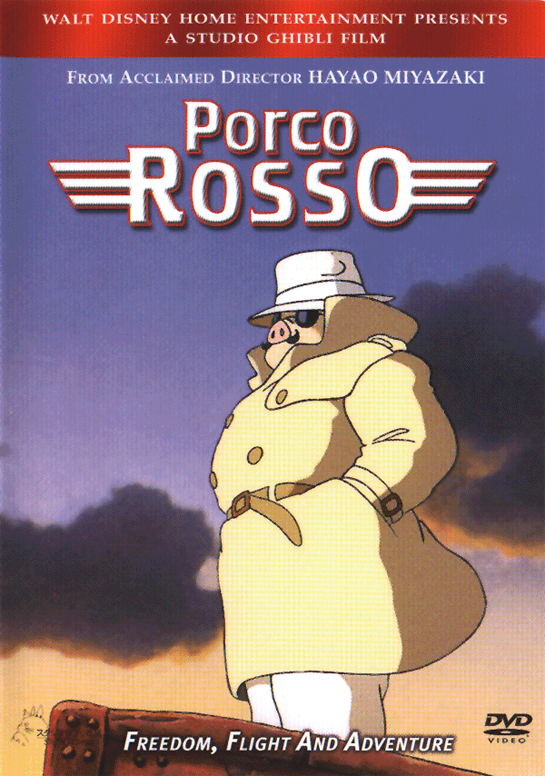
In honor of our upcoming launch (next week: a lot more pigs and a lot more logo) I’d like to give a shout out to a great pig film: Porco Rosso. Japan’s Studio Ghibli films never disappoint with their incredible animation chock full of complex characters and epic story lines (several are inspired by great children’s books). Read More

Cooking is Child’s Play: A French Cookbook for Kids

Favorites

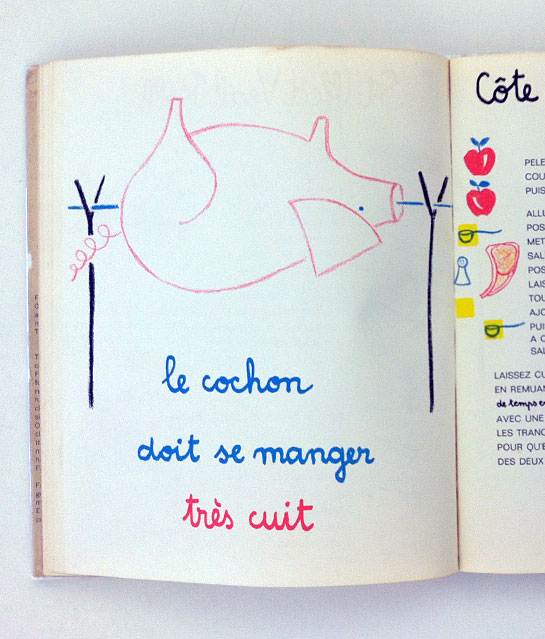
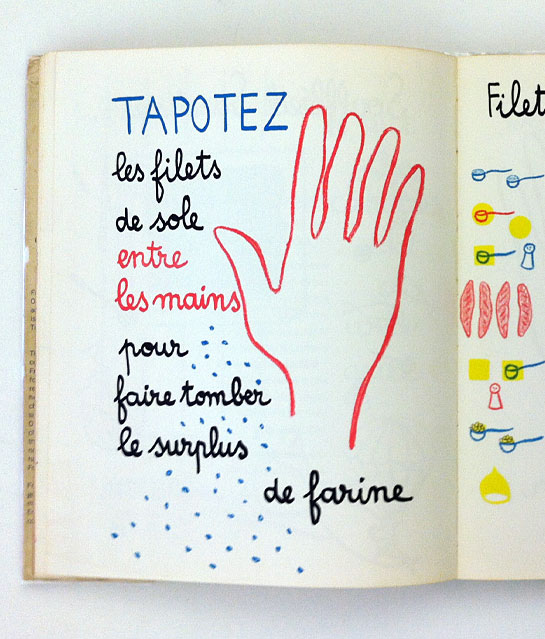
This beautiful vintage French cookbook for kids belongs to my friend, Cybele. Check out that chef baby on the cover! La Cuisine est un Jeu D’enfants was published in 1965 and, according to the jacket flap, “Any child who cooks from this book is well on the road to culinary success, and his elders will have to borrow the book or hire a French chef to keep up with him.” I love the simple, bold illustrations and hand-drawn type by Michel Oliver, the author/illustrator.

La Cuisine Est Un Jeu D'enfants

Cover for La Cuisine Est Un Jeu D’enfants (Cooking is Child’s Play) by Michel Oliver

The preface

An essential recipe every child should learn: whole roast pig.

More interior spreads

An interview with Rob Dunlavey, in which he shares his American children’s book debut (new! better! with more images!)

Interviews / Process

Above: Work for Bayard Presse (Paris): Bonne Nuit Petit Ours. All images courtesy Rob Dunlavey.

Whenever I look at Rob Dunlavey‘s work, I want to sit down with a big pile of crayons, paint, and paper, and get my hands really dirty, because he makes it look just that easy and playful. I am, therefore, delighted that he’s making the move into children’s books. I hope he stays a long while.

Read More

Our faces are red! No, pink!

Uncategorized

Readers,

We are having technical difficulties today. You may have noticed that Rob Dunlavey’s interview was surprisingly short on images, for an illustration blog post. In fact, many more beautiful drawings await! We’ll be re-posting the interview soon, and we hope you enjoy it in all its (intended) glory!

Blushingly,

Pen & Oink

sniff…sniff…a final goodbye to the Donnell

Thoughts

Above: Photo by Kelly Shimoda for the New York Times for this column.

So yes, you are probably thinking: “Enough already! That library closed in 2008!”

But until a few weeks ago, the platform at the 5th Ave E train stop still had the poster for the Donnell library along its wall of cultural institutions as is conveniently still explained here. Read More

The (Re)making of the Pen and Oink Logo

Process / Show and Tell
New oink logo in development

A new oink logo is on its way. Here’s my current idea.

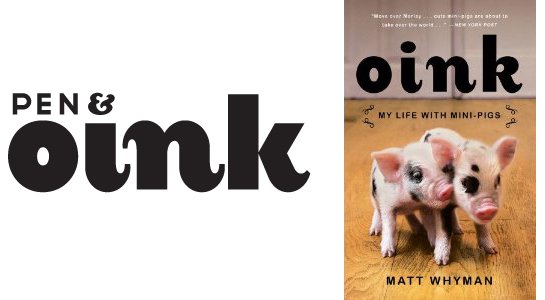
When we decided to start this blog I created the logo below. I chose the font because it felt piggie: chunky and round, and the letters curling up reminded me of pig tails. Well in turns out someone else thought the exact same thing. I got an email from Liz a few weeks later. She was visiting Simon and Schuster and saw a book called Oink on the shelves there. Same word, same typeface. The book came out a year before I created the logo so I felt a bit like a dork having it up on the site. (I swear I didn’t see it before I designed our logo!) So right now I am working on a new logo and I thought I’d give you a preview of the process.

Separated at birth: our original logo and the cover of Oink: My Life with Mini-Pigs. They designed it first.

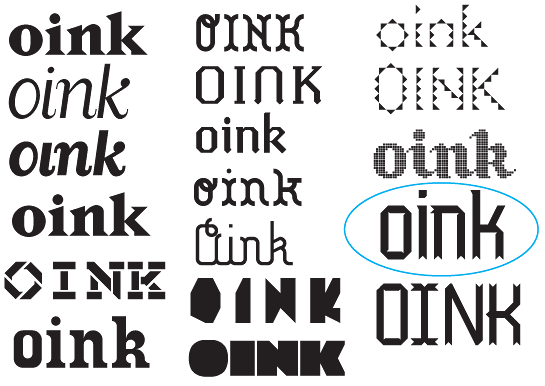
I started by looking at the word, “oink,” in a bunch of different typefaces. I cast a wide net so some of the fonts are pretty wacky. I was hoping to find something that would inspire me to go in a hand-drawn type direction. Some of these fonts I own but some are from a great site with free, downloadable fonts called Fontstruct. 

Oink in different fonts

Lots of wacky fonts. There are no wrong answers in font-storming. The font circled above became the inspiration for the new logo.

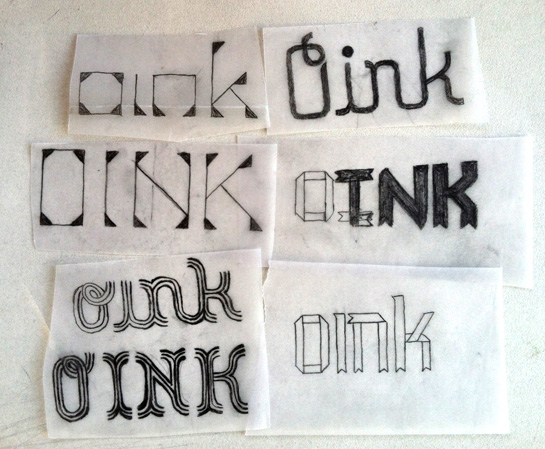
Oink Sketches

Some sketches based on my type inspiration.

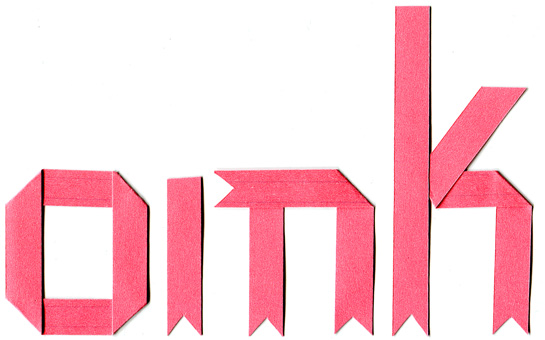
After trying out a bunch of fonts for inspiration I homed in on a font from Fontstruct called Arrowback. The arrowhead ends also look like pig hoofs and I like that it looks like it’s been folded.I played around with a sketches based on this font then decided to make it out of actual paper. Check out the video below!

The plan right now is to photograph the letters and add in some pigs that Liz, Ruthie and I have drawn. And I should probably add “pen &” at some point! Stay tuned for the new logo over the next few weeks.

Making of the Pen & Oink Logo from Robin Rosenthal on Vimeo.

How to make preseparated artwork with tracing paper, a scanner, and Photoshop

Process / Tutorials

Illustration: Liz Starin.

Last week, I discussed the design process for one of the posters in my (EXCITINGLY CLOSE TO ITS FUNDING GOAL) Kickstarter. Today, I’m going to talk about a relatively un-fancy way to make this sort of illustration yourself.

George and Martha: preseparated yet inseparable. (Pay no attention to the lady behind the picture book.) Photo: Jason Reigal.

I made color separations for my posters because they are going to be silkscreened by hand. But once upon a time, children’s book illustrators frequently drew this way–it made the books cheaper to produce. To my generation, this is sort of mind-blowing. A lot of us read Uri Shulevitz’s instructions for making preseparated artwork, in his excellent Writing With Pictures, with some bafflement. Why would we ever need to know how to do that?

Because it looks cool, that’s why. (More on my obsession another time.)

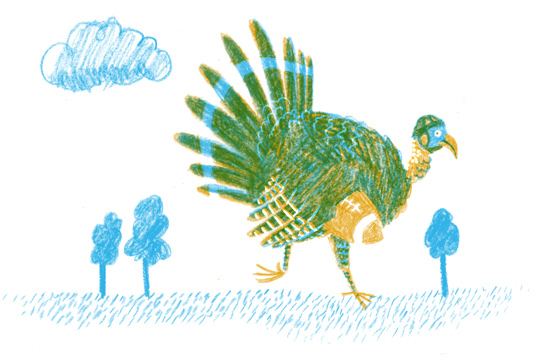
This project, like pretty much all design projects, started with a sketch. Thanksgiving is coming, so, sticking with the animals! playing sports! theme, the obvious choice was a turkey playing football.

Old-fashioned football helmets are funny. They also don’t block your beak.

Once the sketch was sorted out, it was time to think about color. I used just two colors to keep things simple: light blue and pink. Remember, that actually means four colors: blue, pink, purple, and the paper (white).

I don’t think most illustrators do this, but: I tend to plan my colors in writing. That’s the list you see on the side of the sketch. (You’ll notice that I haven’t totally decided which colors to use.) I use this method with paintings, too, but it’s especially useful for this kind of project, which requires some non-intuitive planning.

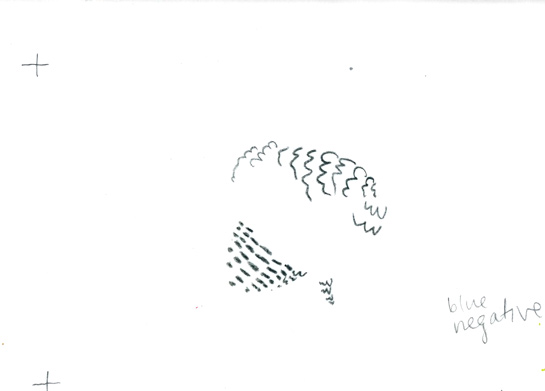
Those crosses are registration marks, for lining up the layers. I taped a piece of tracing paper* over the sketch, and drew new cross hairs. I labeled it with the color it would be: blue. Then, I drew, using my sketch as a guide.
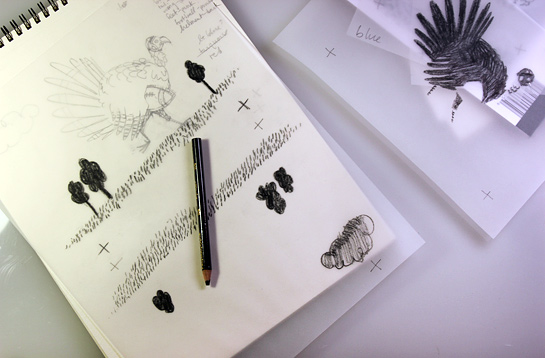
Process (a re-creation).

I worked with a black colored pencil: I wanted to try a scribble-y look, but a regular graphite pencil tends to smear on tracing paper. I colored over all the areas that would be either blue or purple. When I was done, I labeled the paper “blue” and removed it.
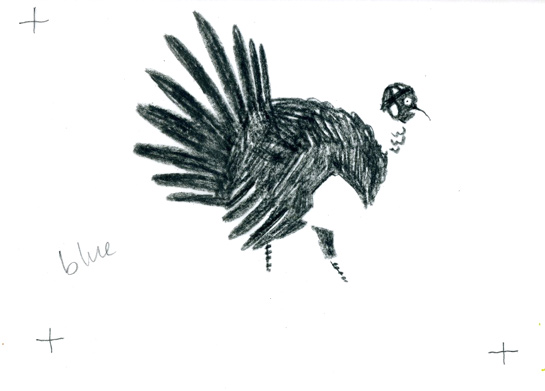
Then I did the same thing for the pink layer, drawing registration marks and then coloring over the areas that would be either pink or purple.

There were also some places where I wanted a negative line. I drew those as separate layers, one for negative pink, and one for negative blue. Here, the drawn parts are areas that will be removed from each layer.

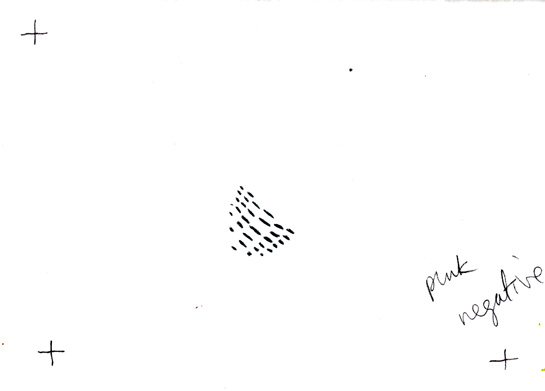
Then, I scanned all the layers and opened them in Photoshop. Scanned tracing paper comes out a bit gray, but I wanted clean white backgrounds. I used the Levels adjustment to fix that. (Layer > New Adjustment Layer > Levels. Either adjust the histogram sliders or select the white eyedropper and click on a place in the drawing that should be white, until everything looks good.)

Now came the fun part. I put all the layers in a single document and set each one to Multiply, using the registration marks to line them up. But they were still black-and-white drawings! So I used the Hue/Saturation adjustment, which is an easy way to turn a b/w image into a single color image. (Layer > New Adjustment Layer > Hue/Saturation. Check the “colorize” box and adjust the sliders to your liking.) I played around until I got a good color combination.
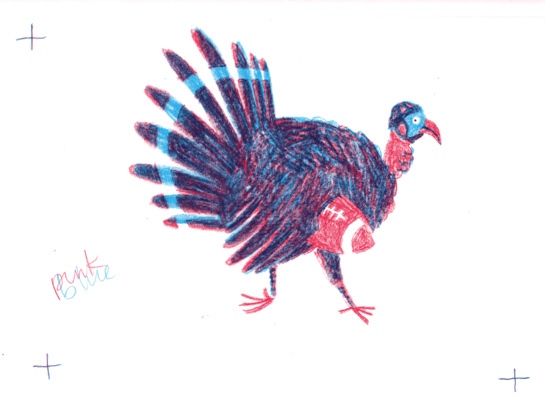
Then I dropped in the negative line. I put the negative blue layer just over the blue layer, inverted it (Command-I on a Mac), and made sure it was converted to a Clipping Mask (on a Mac: control-click > Convert to Clipping Mask; you’ll know because the layer will be indented with a little arrow pointing down). Finally, I set the negative line layer to Linear Dodge, which knocked out those lines from their corresponding layers. I did the same for the pink.***
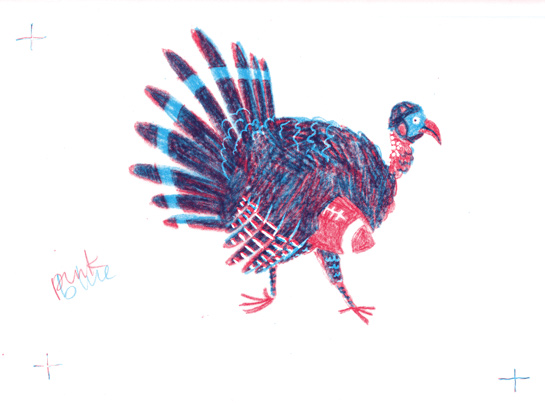
The nice thing about using the Hue/Saturation tool is that it’s really easy to change the colors.** I decided I didn’t like my blue and pink combo, so I changed it to blue and yellow.

But the picture didn’t feel finished. I realized it needed scenery. (In retrospect: duh.) So, I got some more tracing paper and made some.

Here are the finished layers:
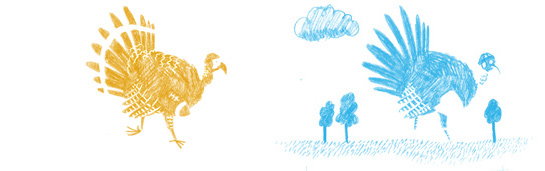
And here is the finished illustration:

And that’s it! I’m ready for my tofurkey now.

CODA: You could, in fact, print these two layers on acetate and use them to make a silkscreen print. The results would be similar, except you’d have a real, physical thing on paper. Which is hard to beat.

*There are a lot of analog ways to make preseparated artwork: Rubylith, construction paper on acetate, regular paper + light box. I chose tracing paper because it is the simplest. Tracing paper won’t always work, though: what if you want to use paint? Or what if you want a grainy paper texture? Choices, choices.

**There are other ways. Again, this one is simple.

***For those paying super-close attention, I also made a few tweaks. Very few, though. Part of the fun of this process is accepting the accidents and mistakes that come along with such a rough way of working.

Bear at the Beach

Featured Books

Above: opening spread from Clay Carmichael’s Bear at the Beach.

Several years ago, my friend Elena held out the book Bear at the Beach by Clay Carmichael and said: “This is a Ruthie book. You need to read this.” And boy was she right. Ms. Carmichael has an incredibly gentle touch when addressing difficult emotions for young readers. Read More